


3
Days
68
Conference Microphones
750
Infrared Receivers
Supporting High-Level Climate Dialogue in the Pacific
Pacific Pre-COP31 brought together leaders, ministers and delegations from more than 50 countries ahead of the COP31 climate summit in Antalya, Türkiye. Held from 5 to 8 October 2026, the Pacific Pre-COP was co-hosted by Australia, Fiji and Tuvalu, bringing global climate decision-makers to the Pacific to advance discussions on key climate priorities.
Working with Event Planning Group, an Identity Company, Congress Australia was engaged to provide conference technology supporting the Fiji plenary and two associated meeting rooms at the Denarau Island Convention Centre.
Client
Event Planning Group, an Identity Company
Venue
Denarau Island Convention Centre, Fiji
Date
5 - 8 October, 2026

The brief combined formal speaking protocols, changing delegate seating and multilingual communication, with conference systems connected to the venue AV and broadcast production.
Designing an Integrated Conference Technology Solution
Congress Australia designed and managed conference microphones, digital nameplates, and automated cameras in the Fiji plenary, along with interpretation equipment and language distribution for the plenary and two associated meeting rooms.
The main plenary featured 68 Bosch DICENTIS wired conference microphones and 68 digital nameplates, configured around delegate seating arrangements and country identification. Six view-only displays let the Chair, Secretariat and Show Caller follow speaking requests and identify active speakers within the seating layout, while Congress operators retained microphone control.

Country labels on the seating map helped the Chair identify who was speaking and locate them in the room.
Congress developed a dedicated nameplate application to prepare, preview and upload custom artwork to the digital nameplates. Using the event's specified Mozaic typography, the artwork accommodated country names and official role labels while maintaining a consistent appearance across the room. The application matched the artwork to the corresponding nameplate seat assignments.
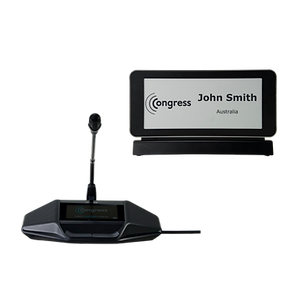
Conference Microphones and Nameplates

Automatic PTZ Cameras
Interpretation Equipment and Infrared Receivers

For automated speaker coverage, Congress integrated nine Avonic PTZ cameras, including a dedicated Chair camera, with MVI automation. Each microphone position was mapped to prioritised camera presets, allowing the system to automatically select an appropriate camera view when a delegate’s microphone was activated. Two PTZ controllers enabled manual operation when required, while camera feeds were integrated with the wider event production.
Congress supplied an Audipack interpreter booth, Bosch interpreter consoles and infrared language distribution for the plenary, supporting client-supplied interpreters. Across the three meeting rooms, 750 infrared receivers and 12 radiators provided delegates with access to interpreted audio.
The Rewa Room, used for bilateral meetings, and Orchid Ballroom, used for bilateral meetings and press conferences, shared a separate onsite interpreter hub with an Audipack interpreter booth. Designed for non-concurrent interpreted sessions, the system routed audio and reference video from the selected room to the interpreters, then returned interpreted audio for distribution to delegates. This configuration allowed both meeting rooms to share interpretation infrastructure, reducing the need for separate interpreter booths in each space.
Congress designed the audio and video interfaces connecting its conference systems to the venue's wider AV and broadcast infrastructure. These included separate conference microphone audio zones, a dedicated Chair feed, Dante integration and camera outputs. Working alongside the event's technical partners, Congress coordinated these connections to support the wider production requirements.
“The event was a genuine success, and that is due in no small part to the work of your team, often to tight timeframes and through changes to the program at short notice.”
- Mik Auckland, Project Director, Pre-COP31, Event Planning Group
Managing Complex Diplomatic and Technical Requirements
Managing Diplomatic Requirements
A key challenge was accommodating changing delegate seating arrangements and the event’s agreed speaking protocols. Because microphone activity also triggered automated camera coverage, seating changes affected digital nameplates, microphone assignments, speaking queues, and camera presets.
Congress prepared separate seating plans, nameplate artwork and meeting configurations for different sessions, including distinct morning and afternoon arrangements where required. Congress coordinated updates across physical seat positions, country and role labels, microphone assignments, and the information presented to the Chair and technical operators. The technical team managed speaking queues in line with the agreed protocols and adapted camera configurations as seating arrangements changed.
Integrating with venue AV and broadcast production
Congress coordinated microphone, interpretation and camera feeds with the venue audio and broadcast teams, adapting the handover design to simplify production routing.
Separate microphone audio zones and a dedicated Chair feed provided the outputs the wider production needed. The teams refined how they combined these feeds at the production audio console, avoiding duplicate processing within the conference system.


Coordinating International Delivery and Technical Commissioning
Delivering conference technology in Fiji required coordinating international freight, customs clearance, venue access, and installation schedules. Working with Event Planning Group and local partners, Congress coordinated the deployment of equipment and technical resources from Australia.
Detailed commissioning and rehearsals were essential to ensure microphone controls, camera presets, interpretation equipment and production interfaces worked together as required. Congress's technicians worked alongside production partners to test and refine the systems, accommodating evolving technical requirements ahead of the event. Congress also prepared a dedicated Chairperson and Aide Guide covering microphone operation, speaking queues, Chair Priority and automated camera coverage.
Clear Speaker Identification and Flexible Meeting Control
Congress Australia brought microphone control, digital nameplates and automated camera coverage together in the Fiji plenary, alongside interpretation equipment serving the plenary and two associated meeting rooms.
This gave the Chair, Secretariat and Show Caller visibility of speaking requests and active speakers within the seating layout. At the same time, Congress operators managed microphone control and adapted configurations as meeting arrangements changed.
Working closely with Event Planning Group and the wider production team, Congress connected these systems to the event’s audio and broadcast infrastructure, supporting multilingual discussions and coordinated speaker coverage.
Planning a High-Level Meeting or Event?
Speak to an Event Producer

